- محدودیت زمان: ۱ ثانیه
- محدودیت حافظه: ۲۵۶ مگابایت
Amin records the price of his stock every now and then as a data point \((t_i, p_i)\) in his notebook, where \(p_i\) is the price of his stock at day \(t_i\). The sequence of these data points represents a piecewise-linear function \(F\) displaying the history of prices over a period of time. Indeed, \(F\) connects every pair of consecutive points by a straight line segment. If the price is not recorded for some day \(t\), \(F(t)\) can be used as an estimate instead. His collected data is getting larger and larger as he has been tracking the price of his stock over a long period of time. Therefore, he has decided to reduce his data by throwing away some of his recoded data points and constructing a new piecewise-linear function \(F\)′ with the remaining points. \(F\)′ is a so-called “simplification” of \(F\). Amin wants to create the simplification in such a way that \(F\)′ is a good approximation for \(F\). To this end, he has defined an error measure as follows.
Let \(F\) be defined over a strictly increasing sequence \(L = \langle t_1, \dots, t_n \rangle\) of days, and \(F'\) be defined over a subsequence \(L' = \langle t'_1, \dots, t'_m \rangle\) of \(L\), where \(t'_1 = t_1\), \(t'_m = t_n\), and \(F'(t'_i) = F(t'_i)\) for \(1 \leq i \leq m\). (We call \(m\) the size of \(F'\).) The error of \(F'\) is defined as the maximum of \(|F'(t_k) - F(t_k)|\) for all \(1 \leq k \leq n\).
For example, in the following figure, we have \(6\) data points, labeled \(1\) through \(6\), whose coordinates are the same as those presented in the second sample input, and \(F'\) is a simplification of \(F\) of size \(3\) with data points \(1\), \(4\), and \(6\). In this figure, \(F\) is depicted by solid lines, and \(F'\) by dashed lines. The error measure for \(F'\) is realized by the vertical distance of point \(2\) to \(F'\).
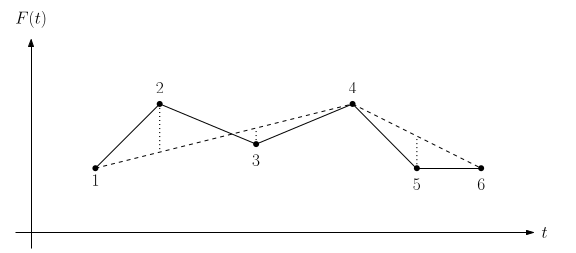
Amin’s goal is to minimize the size of \(F'\) , while the error of \(F'\) is bounded by a given value \(\delta\).
ورودی
The first line of input contains a positive integer \(n\) (\(2 \leq n \leq 2000\)) that shows the size of \(F\). Each of the next \(n\) lines contains two integers \(t_i\), \(p_i\) (\(1 \leq t_i,p_i \leq 10^6\)), where \(p_i\) is the price of the stock at day \(t_i\). The last line contains the error limit \(\delta\) which is a non-negative integer at most \(10^6\).
خروجی
In the output, print the minimum possible size of \(F'\).
مثالها
ورودی نمونه ۱
3
1 10
3 100
10 20
90
خروجی نمونه ۱
2
ورودی نمونه ۲
6
10 10
20 20
35 14
50 20
60 10
70 10
8
خروجی نمونه ۲
3